Andrew Brennan on integrating Learner Voice at our 2nd annual Symposium
2023 Learner voice symposium keynote - andrew brennan
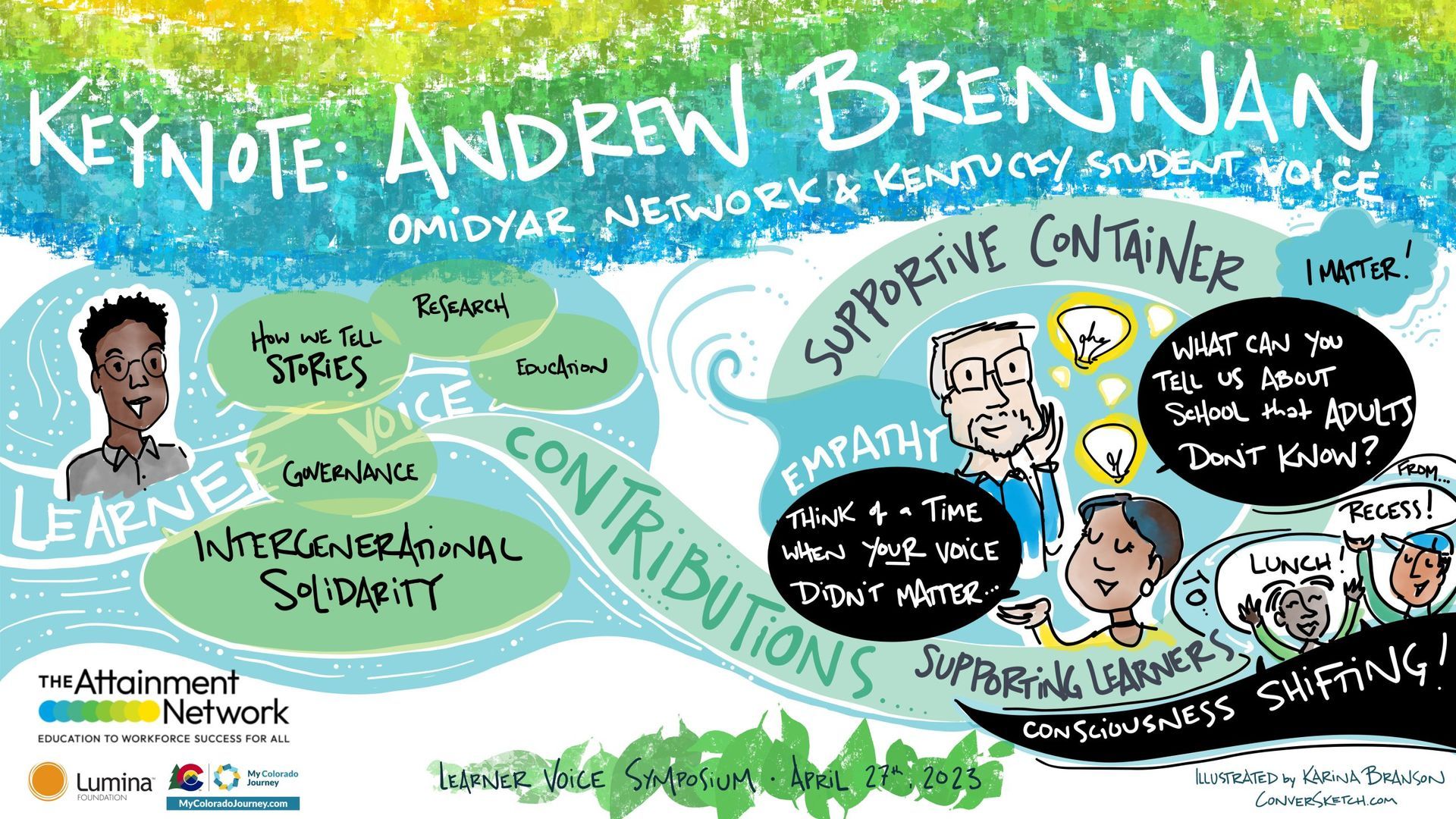
We were delighted to have Andrew Brennan as our Keynote Speaker at the 2nd Annual Learner Voice Symposium. As a High School Junior, Andrew co-founded the Kentucky Student Voice Team, which helps to amplify and elevate students as partners in improving Kentucky schools. The group has led multiple successful legislative campaigns, published original peer-reviewed research, and changed the narrative in Kentucky about the role students can play in creating more just and democratic schools. Today in addition to serving as board chair at the Kentucky Student Voice Team, Andrew is an associate at The Omidyar Network.
Andrew advocates for a “Whole of System” approach to incorporating Learner Voice, Agency and Power. From his experience, the learner’s voice can have a transformative impact on research, policy and storytelling. For too long, decisions have been made that failed to engage the education system’s primary stakeholders – students – who spend 35 hours in the classroom. The benefits of embracing Learner Voice can extend beyond the four walls of a classroom and has the potential to drive and improve system outcomes for all stakeholders.
Andrew challenges us to shift our mindset on education policy and take a more holistic approach to the “intersectionality” of problems facing today’s youth. As an example, social media platform regulation may not be an educational policy, but it plays an integral role in the mental and behavioral health crisis that pervades our schools and student’s lives. Andrew highlights some concrete tools that support more understanding and effective communication between generations:
- Invest in spaces where educators can hear from learners directly e.g., board rooms, education policy committees.
- Bring small groups of students together for critical conversations using a facilitator close in age, near-peer support, to create trust and a more open conversation.
- Use School Climate Surveys developed with young people as research designers rather than just “subjects”. Ensure results are made available quickly as students move on within a year or two.
- Student journalism can present the voices of students and provide a counterbalance to the current conversation which is dominated by politicians, parents, and teachers.
- Support Student Council beyond an event planning tool. Help Student Councils become a place where student perspectives are incorporated into curriculum and policy decisions.
- School based decision-making councils or district school boards present an opportunity to integrate learner representation. When learners are represented on these critical governance committees they can amplify and enhance the policies and create policy feedback loops.
- The education advocacy community should engage learners as part of their advocacy. Learners are very compelling advocates in both local and state government, appearing neutral as they’re representing their own self-interest in getting a quality education.
- Find ways to integrate young people into advocacy organizations, or partner with youth lead organizations. Bridging the gap between adult and youth advocates will yield substantial returns.
In all these approaches, honor the agency that young people bring to the table. It is important to note that Learner Voice is not a silver bullet. Learners don’t have all the answers, but their experiences and perspectives can still make an impact, especially when we are intentional and strategic in including Learner Voice.
RECENT ARTICLES