Incorporating Learner Voice – Hearing from The Experts of Their Experience

June 6, 2023

IMportant insights from the 2023 Learner Voice Symposium
At The Attainment Network, we envision innovative education-to-workforce systems that develop a diverse and talented workforce. We believe in supporting learners and preparing them for future jobs, so they are able to meet economic demands and sustain thriving communities. 

Prioritizing and sustaining focus on the learner’s experiences is a critical component of the work needed to erase persistent and pervasive equity gaps, expand opportunities for learners, and meet the economic demands for a highly skilled and educated workforce system of the future.    

Our second annual symposium brought together an audience of educators, employers, and policymakers to hear directly from Colorado learners what they seek in career-connected pathways and how they define success. 

The Symposium elevated insights from learners’ diverse experiences and backgrounds and provided actionable measures to improve and expand pathways for all learners. 


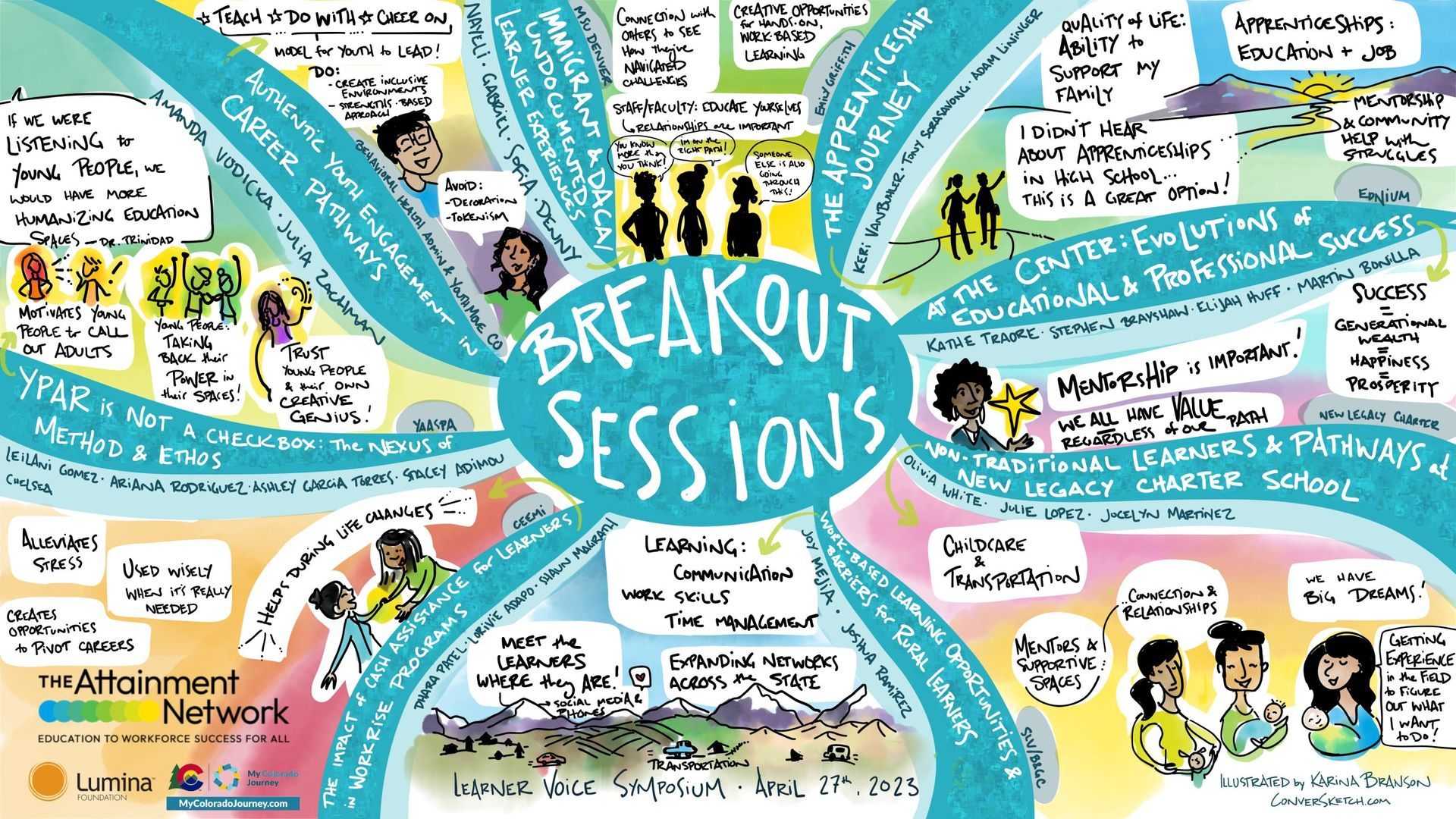
Non-Traditional learners and pathway at New legacy Charter school

New Legacy Charter School (NLCS) enrolls and supports pregnant and parenting learners as well as their children in a unique two-generation setting. In addition to providing education for learners, New Legacy is rated in the top 5% of early learning centers in Colorado. High school learners at NLCS graduate at twice the rate of the national average for teen parents.

The panel of learners spoke about their experiences as learners and moms. All of the learner panelists have big dreams for their careers and personal lives, fueled by the individualized and supportive programming of NLCS. Learners have options to engage in concurrent enrollment and career exploration while at NLCS. 

  • Two of the largest challenges and concerns faced by learners are transportation and childcare. While in school NLCS learners have access to the early learning center for their children and -transportation is available as needed. 
  • Learners shared how valuable it is to have advisors and mentors; people to help them navigate different educational and workplace settings. Additionally, connecting with others who share similar life experiences has been supportive and motivating for the learners. 
  • Learning basic skills (i.e. essential or durable skills) like managing household finances, your credit rating or preparing a resume and cover letter are an important part of their high school education. Simple lessons make a big difference. 
  • Learners desire early connections with college advisors to create relationships to support transition to postsecondary. 
  • Parenting learners have big dreams for themselves and a deep desire to support their kids and make their families proud! 
  • Internships are a critical way to find out what you want to do without being lumbered with student loan debt: “I don’t think I would have figured out I wanted to be an ultra-sound tech, without actually getting to EXPERIENCE the field.” 


At the Center: Evolutions of Educational & Professional Success by Ednium: The Alumni Collective

Ednium: The Alumni Collective hosted a panel of four alumni that discussed their experiences navigating through a school system whose definition of success was sometimes at a mismatch with their life outcomes. Despite this, they shared what made their unique experiences meaningful and how they were able to navigate these complex systems to achieve educational and professional success. 

  • Mentorship is important and valuable; some mentors reflected that they didn’t have similar supports along their journey and were vulnerable enough to admit that they really needed them. Regardless, it was important for them to be a mentor to future generations. 
  • The spaces that value you as a person, and make you feel comfortable the way you are, are the ones that drive the most success.   
  • Following the High School – College – Job path doesn’t exactly work as employers are often looking for work experience even for entry-level hires. 
  • From the learner perspective: Even if we didn’t go to high school, college, or have certain types of jobs, we still have VALUE. 
  • Success = generational wealth = happiness = prosperity 


WORK-BASED LEARNING OPPORTUNITIES AND BARRIERS FOR RURAL LEARNERS WITH SAN LUIS VALLEY BOYS & Girls Club

San Luis Valley Boys & Girls Club hosted a panel with participants of a work-based learning program discussing the challenges and accomplishments while being in the program. B&GC/SLV provides candidates with meaningful career-focused learning experiences in a variety of fields. Program Directors connect learners with employers that are active in their fields throughout the San Luis Valley. 

  • The program helped improve essential/durable skills such as confidence, communication, work skills, and time management 
  • Learners recommend a stronger social media presence (e.g. TikTok) and texting to reach learners and help them understand the opportunities of work-based learning programs – meet the learners where they are! 
  • Create more activities in neighborhoods and communities to expose more learners to the program. 
  • Creating opportunities for learners to engage and expand networks and connect with other learners across the state would be exciting! 

THE APPRENTICESHIP JOURNEY WITH EMILY GRIFFITH TECHNICAL COLLEGE

Emily Griffith Technical College (EGTC) shared details of apprenticeships and held a panel discussion with students about their experiences along their apprenticeship journeys. EGTC offers career and technical programs in health, skilled trades, information technology, service industries and business with partners across Colorado. 

  • High schoolers often aren’t presented apprenticeships as an option. Sharing the benefits of learning on the job, getting paid and low-no debt makes apprenticeships an attractive option. Include more types of hands-on learning in High School curriculum.   
  • Community support and mentorship in the program is an important aspect of its success, helping the learners overcome any obstacles and thrive in their role. 
  • The quality-of-life impact of apprenticeship programs can be huge, as well as the potential for improved confidence and creating an interest in learning where learners directly apply what they learn in the classroom to their job. 


IMMIGRANT & DACA / UNDOCUMENT LEARNER EXPERIENCE WITH MSU DENVER

Learners from MSU Denver’s Immigrant Services Program shared their experiences navigating their education-to-career pathways. Having connections with others in the immigrant community as well as those with an understanding/awareness of relevant resources was a common theme of positive support. Some of the largest barriers to success for these learners included challenges related to limited access to resources, targeted information, financial aid, and particularly work-based learning opportunities based on their immigration status. Learners emphasized that it is not enough to just provide support in navigating the current system, but the system actually needs to change to meet their needs. As one student put it, “our ‘out of the ordinary’ stories are far too common to be perceived as exceptions to the rule.” 

  • Importance of relationships with advisors, faculty, and with other students to garner trust, connect to resources, and build a supportive community. 
  • Staff/faculty should do everything they can to be informed when working with DACA/Undocumented students. They need to educate themselves so they can provide information to learners about Financial Assistance, college & career processes, and what career opportunities can look like with various immigration statuses. 
  • Hands on/work-based learning opportunities need to be varied and creative. How students can and want to show up varies depending on their immigration status. 
  • Connecting to others in immigrant community is essential for learning how others have navigated similar challenges and what resources they’ve utilized. 


THE IMPAct of cash assistant for learners in workrise programs with ceemi

Colorado Equitable Economic Mobility Initiative (CEEMI) created a program called Cash for Coloradans and Evidence for Equitable Upskilling. CEEMI is partnering with 3 organizations – Center for Employment Opportunities, CrossPurpose and ActivateWork – to pilot programs offering cash assistance to learners participating in upskilling opportunities and to conduct research into the impact of such programs on learner success. 


  • Cash assistance helps replace income when changing field, paying for a postsecondary pathway like a bootcamp or simply keeping a roof over your head. 
  • Alleviates the stress of financial uncertainty when you are trying to make a change. 
  • Don’t make assumptions; People who really need cash assistance to support their education and work goals will use it wisely. 
  • Creates a chance for someone to pivot and switch careers. 

youth participatory action research (ypar) IS NOT A CHECKBOX: tHE NEXUS OF METHOD AND ETHOS WITH yAASPA

The organization Young Aspiring Americans for Social and Political Activism (YAASPA) recognizes the challenges youth face in navigating their academic, career, and civic development in the social sciences and public service careers in Colorado. YAASPA works to cultivate youth to be civically engaged in community and career by building the self-efficacy of youth. This session focused on Youth Participatory Action Research (YPAR) as a key approach to center learners and their experiences in the development of career pathways.   

  • YAASPA highlights that many of the decisions related to career pathways (e.g. which career pathways to develop and how) have been made from a top-down perspective, based on labor market demands in STEM, business, health, and other high demand fields. Consequently, there have been few endeavors to cultivate self-efficacy for youth who desire to pursue a social justice career and/or pursue degrees and careers in the social sciences. As Dr. Trinidad discussed during the symposium, “If we were listening to our young people, we would have more humanizing education spaces.”   
  • YAASPA tactically puts youth in positions of power as a means to cultivate agency and empowerment. The organization challenges us to “trust young people and their own creative genius.”   
  • Centering youth expertise in youth participatory action research (YPAR) provides the authority to youth “to call out the adults in their lives” and “take back power in their spaces.” 

AUTHENTIC YOUTH ENGAGEMENT IN CAREER PATHWAYS HOSTED BY COLORADO BEHAVIORak health administration & youthmove co

Youth MOVE National is a youth-driven, chapter-based organization dedicated to uniting the voices of youth nationwide. Youth Move asserts that youth are the leaders of today, not tomorrow; all youth should be equal partners in the process of change; and that youth can motivate others through their voices of experience. 

The YouthMove team talked about authentic youth engagement. When engaging youth, avoid tokenism and decoration to prevent burnout and hopelessness. Instead, create a more inclusive, empowering environment that continually addresses power dynamics. 

  • Cultivate environments where youth may more readily share their creativity, honesty and guidance 
  • Create inclusive environments where the youth feel a sense of belonging. Ensure the engagement is culturally responsive. 
  • Honor the understanding and expertise youth bring to your organization. 
  • Ask young people what they want out of their time with your organization or relationships with you. Be transparent and provide clarity. 
  • Maintain a strengths-based approach – seeing everyone’s superpower and honoring youth’s expertise and lived experience. 
  • Youth need a multitude of models such as: teach, do with, cheer on, for youth to lead in spaces. 


RECENT ARTICLES
July 2, 2026
As our nation celebrates 250 years, we're inspired to keep building toward a future where opportunity is within reach for every learner and earner. Throughout July, The Attainment Network team will join partners across Colorado and the country to strengthen career-connected learning, expand economic mobility, and build systems that help every learner and earner thrive. Here’s where you can find us this July: 🗓️ July 1 🔹 Colorado Space Institute Space Educator Bootcamp Celebration – Castle Rock Emily will join education, industry, and workforce partners to celebrate the Colorado Space Institute’s Space Educator Bootcamp and explore how educators are bringing space science and STEM learning into classrooms across Colorado. 🗓️ July 10 🔹 Regional Accountable Entity 1 San Luis Valley Programs Improvement Advisory Council Meeting – Alamosa Wes will join healthcare providers, community organizations, and regional leaders working together to strengthen healthcare programs and address the social determinants of health across the San Luis Valley. 🗓️ July 13-15 🔹 CU Badge Summit – Boulder Stefan will attend this national convening focused on the future of digital credentials and how they can expand learning and career opportunities. 🗓️ July 14-16 🔹 College Board District Success Network Conference – Denver Rana will serve on a panel exploring how schools can help students connect classroom learning to future college and career opportunities. 🗓️ July 16 🔹 Postsecondary Talent Development System Transition Advisory Committee – Denver The Transition Advisory Committee, including our own Michelle Camacho Liu, reconvenes to continue developing recommendations to guide Colorado's new unified postsecondary talent development system. 🗓️ July 20-21 🔹 ECMC Research Gathering: From Questions to Change – Minneapolis Stefan will join ECMC Foundation partners from across the country to explore how research, policy, and practice can work together to drive meaningful systems change. 🗓️ July 23 🔹 Construction Pathway Meeting – Alamosa Ashley and Wes will reconvene with education, workforce, and industry partners in the San Luis Valley to continue building a shared strategy for strengthening construction career pathways across the San Luis Valley. 🗓️ July 30 🔹 Colorado Society of Certified Public Accountants Summer of Fun – Colorado Springs Michelle Payne will connect with accounting professionals, educators, and employers to explore trends in the profession and opportunities to expand mentorship and internship pathways. If you’ll be at one of these events or working on something similar, please reach out. We’d love to hear from you. 
July 2, 2026
Great apprenticeship programs don't stand still. They evolve.
July 1, 2026
By Reanna Werner, Co-Founder & Chief Problem Solver, Savvion HQ When we talk about Colorado’s workforce challenges, the conversation often starts with hiring. Employers need more applicants. They need stronger applicants. They need people who show up, communicate, solve problems, stay through the hard parts, and grow into leadership. From my vantage point as co-founder of Savvion HQ, I spend much of my work alongside small business owners who are trying to grow responsibly while navigating real-time challenges in hiring, payroll, HR, compliance, leadership, and retention. I am also helping shape the Careers in Hospitality initiative in partnership with the Pikes Peak Workforce Center and Visit Colorado Springs, which has given me an even closer look at how these workforce pressures are playing out across one of our region’s most people-centered industries. What I see is this: hiring is not the whole story. Hiring is the symptom. The deeper issue is that our education, workforce, and employer systems are still too often operating in separate lanes, while employers are trying to navigate one very real, very connected road. That disconnect is especially visible in hospitality and tourism. Hospitality is one of the most people-centered industries in our region. It is also one of the most misunderstood. Too often, students and families see hospitality as a temporary job, not a career pathway. But those of us working closely with employers know the industry is full of opportunities in operations, management, sales, events, culinary, finance, maintenance, marketing, guest experience, and entrepreneurship. The challenge is that the pathway is not always visible. Through Careers in Hospitality, we are working to build a clearer education-to-workforce pathway for one of the Pikes Peak region’s most people-centered industries. This work is being modeled in part after Careers in Construction, a highly successful local program that has already shown what is possible when industry, education, and workforce partners come together around a shared talent pipeline. Their support and guidance have been invaluable as we think through how to adapt a proven framework to the hospitality and tourism sector. We recently had the opportunity to work with MBA graduates from UCCS who used our program as their capstone project. They surveyed hospitality and tourism executives and general managers across the Pikes Peak region to better understand workforce challenges, skill gaps, and employer interest in education-to-workforce partnerships. The report included 39 valid responses from hotels, attractions, event venues, food and beverage businesses, cultural and historic centers, sports and community organizations, transportation services, and other tourism-adjacent organizations. The results were not shocking, but they were clarifying. Employers identified wage competition as their top workforce challenge at 56%, followed closely by hiring qualified candidates at 51% and leadership pipeline concerns at 49%. Retention, attendance and reliability, and scheduling availability each came in at 38%. That tells us something important. Employers are not facing one isolated hiring problem. They are dealing with a layered workforce challenge that includes compensation pressure, readiness gaps, reliability concerns, and a shortage of emerging leaders. The skill gaps were even more telling. Employers reported that today’s applicant pool is lacking communication skills at 74%, time management and prioritization at 72%, customer service at 69%, and customer service techniques at 67%. On the behavior side, the top gaps were resilience at 74%, work ethic and reliability at 72%, service mindset at 72%, and resourcefulness and problem-solving at 72%. These skills are often referred to as soft skills, but that term no longer fully captures their value. Across education and workforce conversations, many organizations are now describing them as durable skills or power skills because they travel across roles, industries, and career stages. I prefer durable skills because that is exactly what they are: skills that hold their value even as technology, job duties, and industries change. In hospitality, communication is not soft. It is the difference between a frustrated guest and a loyal customer. Reliability is not soft. It determines whether a team can function during peak season. Problem-solving is not soft. It is what allows an employee to handle the moment when the reservation is wrong, the room is not ready, the event timeline shifts, or the customer is upset. And this is where AI becomes part of the workforce conversation, not a separate conversation. AI is already changing how employers think about entry-level work. Tasks that are repetitive, administrative, or easily standardized will continue to be supported or reshaped by technology. That does not mean entry-level workers become less important. It means the expectations for entry-level workers are changing. The young person entering the workforce now will need to be comfortable with technology, but technology alone will not make them successful. They will need to know how to ask better questions, interpret information, communicate clearly, adapt in real time, and use good judgment. In a service-based industry like hospitality, they will also need to do the human work that AI cannot replace: reading the room, calming a tense interaction, building trust, showing empathy, and creating an experience that feels personal. That is why durable skills are not secondary to technical training. They are the foundation that makes technical training useful. For employers, AI may eventually help with scheduling, guest communication, training, marketing, revenue management, and back-office functions. But if the workforce pipeline is already struggling with communication, resilience, reliability, and problem-solving, then technology will not solve the core issue by itself. In some ways, it raises the bar. Employees will need both digital confidence and human readiness. That gives education-to-workforce programs a clear assignment. We cannot prepare students only for the tasks that exist today. We have to prepare them for workplaces where technology is changing the task list, but human judgment still determines the outcome. The survey also showed where the pressure is greatest. The hardest roles to fill were maintenance and facilities at 51%, managers and assistant managers at 41%, front desk and guest services at 38%, housekeeping at 38%, and culinary roles at 33%. That matters because some of the most difficult roles to fill are also some of the most important for career exposure. Front desk employees often become the central nervous system of a hotel. Maintenance roles can lead to stable, skilled, well-paying careers. Housekeeping is essential to guest experience and brand reputation. Supervisors and assistant managers become the bridge between entry-level talent and long-term leadership. If students never see those roles as meaningful career pathways, we lose them before they ever enter the pipeline. At the same time, employers are being honest about their capacity. When asked how much time their organization could commit to a workforce development program, 51% said occasional participation, meaning one to two times per year. Another 31% said they could commit to quarterly engagement, while only 15% said they could support ongoing advisory, hosting, or mentoring. That is not a lack of interest. It is a reality check. Employers want to help, but many are running lean. Their biggest limitations were time constraints at 92%, staffing levels at 56%, and cost at 38%. For small and mid-sized businesses especially, goodwill is not the barrier. Capacity is. That means our workforce solutions have to be designed differently. If we want employers to participate, we need to meet them where they are. We need to reduce friction. We need to create clear, practical ways for businesses to contribute without asking them to take on another full-time project. We need to build models that respect employer capacity while still giving students meaningful exposure. One promising approach is project-based learning. Instead of asking an employer to build an entire program from scratch, the employer identifies a real business challenge. Students work on that challenge with guidance. The employer receives useful ideas, fresh perspective, and a tangible result. Students gain exposure to the industry, build durable skills, and begin to understand how classroom learning connects to actual work. That is the kind of partnership employers appear ready for. In the survey, 82% identified better job readiness as a priority outcome, 79% said a stronger applicant pool would matter most, 56% pointed to faster hiring, and 56% pointed to leadership pipeline development. The opportunity is there. The design has to be right. That is one reason the example set by Careers in Construction matters so much. They have helped demonstrate that career pathways become more real for students when employers are organized, educators are supported, and the program structure is clear. Careers in Hospitality is being developed with that same spirit: practical, employer-informed, and built around exposure, readiness, and real opportunity. For Careers in Hospitality, that means starting with attainable goals. We have to prove value early. We have to build trust. We have to show employers that their participation leads to better-prepared students, stronger applicants, and a clearer talent pipeline. It also means helping students see hospitality differently . One respondent said the region needs more awareness that careers in tourism exist beyond being a tour guide. Another pointed to the need to transform the sector from a temporary job model into a professional career pathway. Others highlighted advancement from front desk to management, operations, sales, marketing, maintenance, events, and leadership. That is the story we need to tell. Hospitality is not just a first job. It can be a first step. It can teach durable skills like communication, emotional intelligence, problem-solving, leadership, financial awareness, customer experience, and operational discipline. Those skills transfer across industries, but they can also build long-term careers right here in Colorado. What gives me optimism is that this is not an unsolvable problem. We have employers who care. We have educators who want students to succeed. We have workforce leaders asking better questions. We have students who are capable of rising when they are given exposure, guidance, and a real path forward. But we have to build the connective tissue. Employers need to be clearer about the skills they need and more willing to help shape learning experiences. Educators need stronger bridges to industry so students can see pathways earlier. Workforce leaders need to design programs that are useful, not just well-intentioned. Policymakers need to support flexible, local models that can respond to actual employer needs. Colorado’s workforce future will not be solved by one program, one policy, or one sector working alone. It will be built through practical partnerships that respect everyone’s reality. Students need clarity. Employers need capacity-conscious ways to engage. Communities need pathways that lead somewhere meaningful. If we do this well, we will not just fill open jobs. We will help young people see a future for themselves in Colorado’s economy, and we will help employers become active builders of the talent they hope to hire. Data points are drawn from the April 2026 Pikes Peak Region Hospitality & Tourism Workforce Development Survey Industry Needs Assessment Report and survey output charts.